
How to Choose the Right Air Duct Cleaning Company in Tacoma
A duct cleaning company can carry a wall of five-star reviews and still leave your system dirtier than it started. That happens when the crew runs a shop-vac and a handheld brush into ductwork that needs real negative pressure to keep debris from drifting back through the house. Choosing the right company in Tacoma comes down to one question: can their equipment and their process actually clean the whole system, or just the parts you can see? Here’s the checklist we’d use if we were hiring someone.
If you’d rather not sort through it yourself, call (888) 870-9539 and we’ll give you a free estimate.
What should I ask a duct cleaning company before I hire them?
Ask what they use to create negative pressure in the system. That single question separates contractors who can clean a full duct system from those who can only vacuum near the registers. Negative pressure means the collection unit pulls air (and the debris it carries) out of the ducts while an agitation tool loosens contamination inside, so loosened material travels toward the machine instead of into your living room. A company that can’t answer clearly, or that describes nothing more than a vacuum hose, tells you something useful before they ever arrive.
Here’s the short version of what to ask:
- “What do you use to create negative pressure?” A real answer names HEPA-filtered collection units and containment. At Duct Cleaning Tacoma we run Nikro HEPA-filtered units alongside Abatement Technologies negative-air containment, so what comes loose is captured, not recirculated.
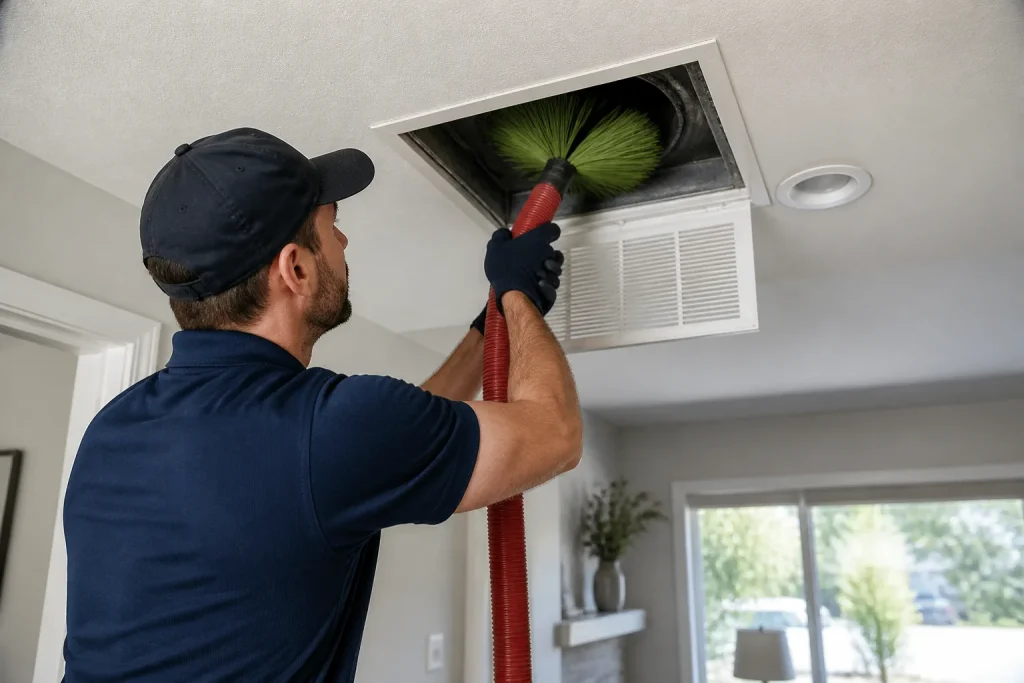
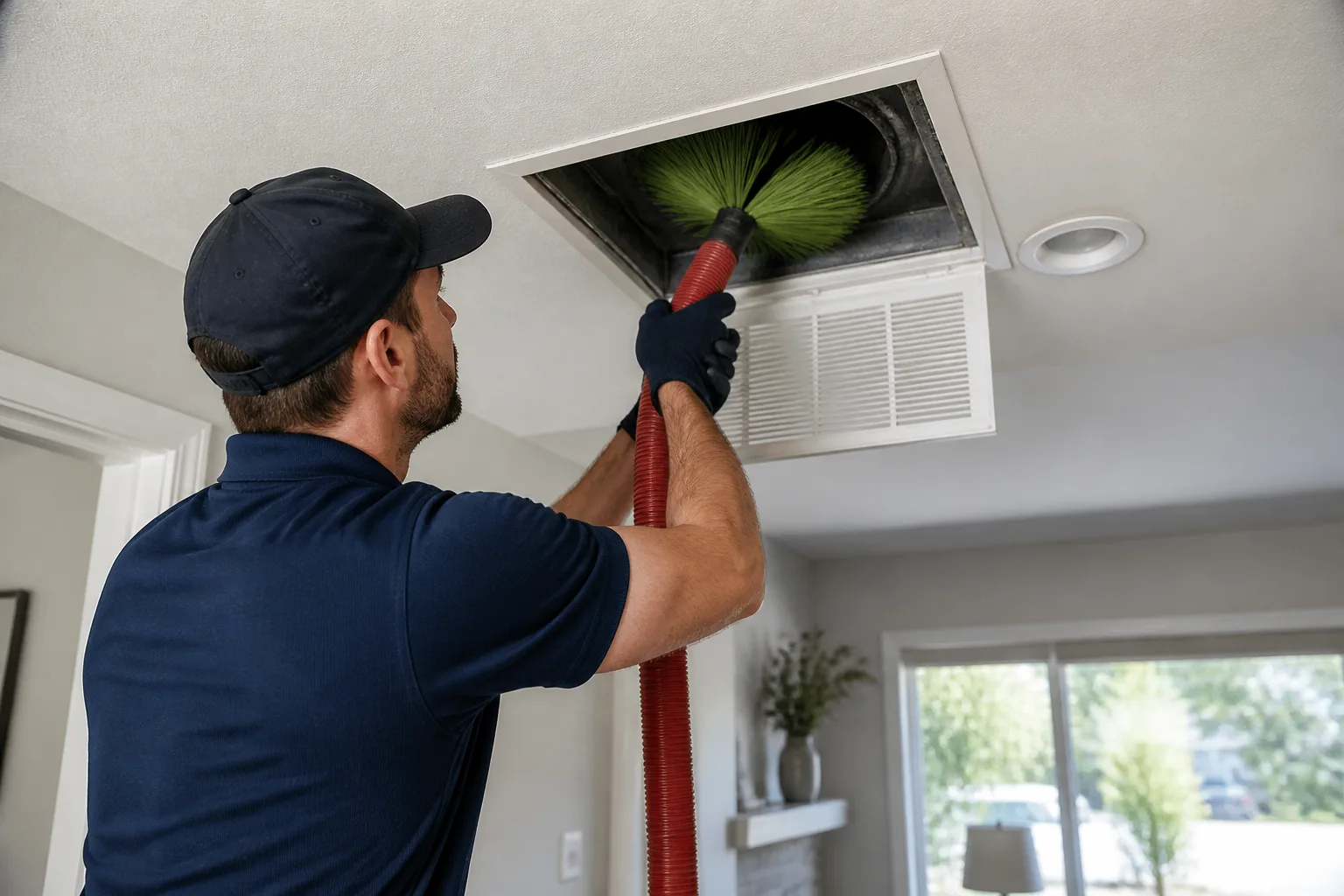
- “What loosens the debris inside the ducts?” Agitation is the other half of the job. We use Rotobrush agitation systems, the industry standard for mechanical duct cleaning, because a brush and airflow reaching the duct walls is what actually removes buildup.
- “Do you include supply and return ducts, the air handler compartment, and every register?” If the quote only covers the visible trunk lines, it isn’t a whole-system clean.
- “What happens if you find damaged or disconnected ductwork?” A specialist has an answer. A clean-only operator usually doesn’t.
None of these questions require you to know the equipment brands. You’re just listening for whether the person on the phone can describe their process in specifics. In Tacoma, where older homes are common, that clarity matters more than a low opening price.
Why does specialization matter when choosing a duct cleaning company in Tacoma?
An HVAC company that offers duct cleaning as an add-on and a dedicated duct cleaning operation are set up differently, and the difference shows in the equipment. A general HVAC contractor’s core work is repair and installation, so duct cleaning tends to run on lighter, multi-purpose gear. A specialist builds the whole operation around duct systems, which is why the containment and agitation equipment is contractor-grade. Our entire focus is three services: air duct cleaning, dryer vent cleaning, and duct repair. Nothing else competes for the truck space or the training time.
That narrow focus has a practical payoff for you. A technician who cleans ducts every working day gets faster at reading a system: where the flex runs go, where a joint has pulled apart under a crawlspace, where a return is undersized for the equipment feeding it. A technician splitting time across furnaces, water heaters and duct cleaning gets less of that pattern recognition. We’re not saying a generalist can’t do a decent job. We’re saying the equipment setup and the repetition are what separate a thorough cleaning from a surface pass.
If you’ve been burned by a cheap offer that turned into a bigger invoice, that’s usually an equipment problem wearing a sales costume. One flat price per system, agreed before work starts, is the antidote. Ask any Tacoma company you’re considering to quote the whole system, not per vent.
What does NADCA membership actually tell you?
NADCA membership tells you a company has committed to a recognized industry process standard. It does not, on its own, guarantee the quality of the work in your home. That’s the honest version, and it’s worth understanding before you use membership as your only filter. The standard describes how a proper cleaning should be scoped and performed: source removal, containment, and cleaning the full system rather than a token pass near the registers. A member company has signed on to that framework. Whether the crew on your job follows it is a separate question.
Use it as one filter among several:
- Membership: a useful starting signal that the company knows the process standard exists.
- Equipment: ask what creates negative pressure and what agitates the duct walls. Listen for specifics, not adjectives.
- Scope: confirm the quote covers supply and return ducts, the air handler compartment, all registers, and the blower housing.
- Proof: ask whether you’ll see before-and-after photos of your own ducts. You should.
Verified process beats a logo on a van. In Tacoma, we’d rather walk a homeowner through the containment setup than lean on a badge. Membership is the floor, not the ceiling.
How do I read a duct cleaning quote for scope completeness?
A complete quote names what’s included, line by line. A vague one says “whole house duct cleaning” and leaves the rest to interpretation, which is exactly where surprise charges come from. Read the quote the way you’d read a contractor’s bid for a remodel: the scope should be specific enough that two companies bidding the same work are describing the same job. And be wary of any quote priced per vent. A per-vent model rewards a contractor for counting registers, not for cleaning the system behind them.
Check that the quote covers:
- Supply and return ducts. Both sides of the system move air, and both collect debris.
- The air handler compartment. The cabinet around the blower is part of the air path and needs cleaning, not just the ducts feeding it.
- Every register. All of them, not the accessible ones.
- The blower housing. A dirty blower wheel throws contamination back into the airstream.
- Containment. The quote should reflect a process that captures debris rather than redistributing it.
If a Tacoma company’s quote lists only the visible trunk lines, the price isn’t a bargain; it’s a smaller job than you think you’re buying. Ask them to re-scope it. If it comes back as one flat price per system with the full scope listed, you’re on solid ground. If you’re shopping around the Tacoma area, hold every quote to that standard and the comparison gets a lot simpler.
What should Tacoma homeowners ask about local duct systems specifically?
Ask how the company handles crawlspace flex duct, older metal ductwork, and combined heat pump and furnace setups common in Pierce County homes. Tacoma’s housing stock ranges from mid-century builds with rigid metal trunks to newer construction where flex duct runs through a crawlspace. Each has its own failure points, and a company that cleans here regularly should be able to talk about them without pausing. Flex duct can sag, tear, or come loose at the collar. Older metal systems develop seams that open up over years of cycling. Heat pump and furnace configurations route air differently and change where debris collects first.
A specialist should also be able to tell you the difference between cleaning and repair, because they aren’t the same job:
- Cleaning removes accumulation from ducts that are structurally sound.
- Repair fixes the integrity of the system itself: reconnecting a separated run, sealing failed joints, replacing damaged flex. We offer air duct repair as a standalone service precisely because cleaning a broken duct system just moves the problem around.
- Beyond the ducts, ask about air quality components. We work with Honeywell and Aprilaire systems, so recommendations connect cleaning to the filtration and humidity equipment already in your home.
And if your dryer has been slow to dry clothes, that’s a different service with a real safety angle. dryer vent cleaning addresses lint buildup that contributes to house fires, which is worth treating as maintenance, not a nice-to-have. A company that can handle ducts, dryer vents, and duct repair under one focused operation saves you from coordinating three contractors.
When should you call a pro instead of handling it yourself?
Call a professional when the job involves the full duct system, negative pressure containment, or any structural repair. Ductwork isn’t a dangerous DIY task the way a gas line is, but it’s a job where the tools determine the outcome. A shop-vac and a long brush can loosen debris into the airstream without capturing it, which can make indoor air worse in the short term. If you can see visible dust blowing from a register, if a run feels disconnected under the house, or if your system hasn’t been cleaned in years, those are signs to bring in the equipment that can do the work properly.
This is where the checklist pays off. Call (888) 870-9539 if you’d like us to look at your system. We answer 24/7, and fast dispatch runs 7am to 7pm, Sunday through Friday. Our technicians have up to 10 years of experience, and the estimate is free with a flat price per system agreed before work begins.
The Bottom Line
Choosing a duct cleaning company in Tacoma isn’t about finding the most five-star reviews. It’s about verifying that their equipment can create negative pressure, agitate the entire duct system, and capture what comes loose. Ask what they use, confirm the quote covers supply and return ducts, the air handler, all registers, and the blower housing, and check that they understand crawlspace flex duct and older metal systems. NADCA membership helps as one filter, not the only one. Reviews tell you a company showed up; equipment and scope tell you what happened once they did.
If you’re in Tacoma and need help, Duct Cleaning Tacoma offers free estimates. Call (888) 870-9539. We answer 24/7. Fast dispatch from 7am to 7pm, Sunday through Friday. One flat price per system, agreed before work starts, with before-and-after photos of your own ducts so you can see exactly what changed.
Frequently Asked Questions
Ask what creates negative pressure in the system and what agitates the duct walls. A legitimate answer names HEPA-filtered collection units and containment equipment, and can explain in plain terms how debris is captured rather than recirculated. If the answer is a vacuum and a brush with no containment, that’s your answer about the equipment too. Call (888) 870-9539 for a free estimate and we’ll walk you through what we use.
No. NADCA membership signals a commitment to a recognized process standard, but it doesn’t guarantee the crew on your job follows it. Use it alongside questions about equipment, scope completeness, and proof of work. Membership is one filter; the quote and the equipment are the others.
Usually because they cover less work. A low quote often means per-vent pricing, visible trunk lines only, or no containment equipment, so you’re paying less for a smaller job than the full system needs. Compare quotes on scope, not on the bottom-line number, and ask each company to list supply and return ducts, the air handler, all registers, and the blower housing. Call (888) 870-9539 for an exact quote on your system; estimates are free.
There’s no fixed schedule that fits every home. It depends on your system, your filtration, whether you’ve had recent renovation or pest activity, and whether ductwork is in a crawlspace where it can collect debris. Many Tacoma homeowners clean every few years and inspect sooner if they notice dust from registers or a disconnected run. A specialist can tell you what your system actually needs after looking at it. Call (888) 870-9539 to book a free estimate.
Written by the team at Duct Cleaning Tacoma.
Need Air Duct Cleaning Help?
Call Duct Cleaning Tacoma - licensed & insured, here with fast help in Tacoma.
(888) 870-9539